


Voters in southwest Fresno, downtown and the Tower District will elect a new councilmember for the first time in eight years on June 2.
Councilmember Miguel Arias, who first won the District 3 seat in 2018, hits his two-term limit this year. The open seat has drawn seven candidates — including a sitting state assemblymember, a Fresno Unified school board trustee, a former school district trustee and four candidates with no prior elected experience. If one candidate wins more than 50% of the vote in June, the race is decided. If not, the top two finishers advance to a November runoff.
Fresnoland interviewed four of the seven candidates: Assemblymember Joaquin Arambula, tradesman Charles Montoya, former school trustee Fernando Alvarez and county caseworker Jalen Swank. Three other candidates — Fresno Unified School Board Trustee Keshia Thomas, Marjaree Mason Center crisis response manager Tiffany Apodaca and engineering contractor Larry Tyrone Burrus — did not participate.
Thomas declined to be interviewed about her campaign. Apodaca and Burrus did not respond to multiple requests for an interview from Fresnoland.
Click below to jump to:
Fernando Alvarez | Tiffany Apodaca | Joaquin Arambula | Larry Burrus | Charles Montoya Jalen Swank | Keshia Thomas
District 3 is geographically and demographically the most varied seat on the Fresno City Council. It includes downtown, Chinatown, Edison, southwest Fresno, the Tower District, Lowell, south Tower, Jane Addams and parts of newer west-Fresno neighborhoods inside the Central Unified school district. It also contains most of the city’s heavy industrial parks.
The 93706 ZIP code, which spans much of southwest Fresno, has a life expectancy roughly 20 years shorter than the Bullard High area in northwest Fresno, a gap many candidates referenced as a reason for them running. Census tracts in southwest Fresno sit in the 99th percentile on California’s CalEnviroScreen index for cumulative environmental burden.
Several long-running fights affecting neighborhoods in the district are now reaching the Fresno City Council. A roughly 60-acre swath of mixed-use land along Elm Avenue is the subject of a years-long rezone battle between the city, an out-of-town landowner partnership and southwest Fresno residents. The proposed rezone would take the 60-acre site back to industrial zoning, erasing about 500 housing units from the city’s General Plan; the 2017 Southwest Fresno Specific Plan called for the area to be mixed-use.
Also at the top of candidates’ minds was Mayor Jerry Dyer’s plan to build a second downtown on roughly 9,000 acres of southeast Fresno farmland — known as SEDA. The project is currently winding through the council. The next D3 councilmember could cast one of seven council votes on whether to approve SEDA despite its $3 billion funding shortfall, if approved in its current form.
Voters this June will also see the future of Measure C take shape — Fresno County’s half-cent transportation sales tax, which has funded local roads for decades, and expires this year. Two rival ballot initiatives are jockeying to replace it: a Dyer-backed, city-led measure shaped through community input that would direct more funding to public transit, bike lanes and safe routes to schools, and a rival measure championed by former Caltrans consultants and former county supervisor Henry R. Perea that would steer more money to highway expansions and road repair, leaving less for public transit.
And as federal pandemic-era funds expire, Fresno faces a homelessness funding cliff. The city is on track to lose hundreds of emergency shelter beds, and pressure is mounting on the city’s eviction protection program — which provides legal aid to renters facing displacement — at a moment when Fresno has consistently ranked among the hottest rental markets in the country.
The next councilmember will also inherit two open questions about how the council itself does business. The ACLU and the First Amendment Coalition recently won a lawsuit against the city over the council’s budget subcommittees — where much of the city’s spending is hashed out — for operating in violation of the state’s open-meetings law. The city, however, decided to not have a budget sub-committee to comply with the law, meaning budget negotiations are held privately. And calls have grown for an independent ethics commission — like those in San Francisco and San Jose — to investigate questionable conduct that the city attorney, who answers to the council, has so far declined to pursue.
Read more about where the candidates — ordered alphabetically by last name — stand on these issues below.
What does a Fresno City Councilmember do?
There are seven seats on the Fresno City Council representing distinct geographical areas.
The council makes decisions on the scope, direction and financing of city services, such as water, sewer, police and fire protection. They’re also in charge of approving the city’s $2.5-billion annual budget that the Mayor prepares every spring.
The council also establishes policy that is administered and implemented by city staff, as well as land-use policies through the General Plan and zoning regulations.
Councilmembers serve four-year terms and have a two-term limit.
As of January 2025, councilmembers receive yearly compensation of $111,320. The council president is compensated at a rate 12.5% above that, or about $125,235.
Fernando Alvarez

- Job: Small business manager, former West Park Elementary School District Trustee
- Age: 24
- Residency: Born in southwest Fresno, graduated from Edison High School
- Notable Endorsements: Fresno Chamber of Commerce, former Supervisor Henry R. Perea
Alvarez’ first glimpse of public service was when he was elected to the West Park school board at 21, which he said made him one of the youngest elected officials in Fresno County history. He served on the board until recently. His proudest accomplishments, he said, included a $5 million school modernization grant, a curriculum update and the purchase of 33 acres of farmland across the street from the school for a future agriculture program.
“One of the biggest ways you can bring power back to the people is recovering some of the land we’ve lost over time,” he said.
After leaving the board, he spent three years in government affairs at the Fresno Chamber of Commerce — a tenure he said gives him an unusual perspective on land-use disputes. He has not held office since.
What is his position on the Southeast Development Area plan, or SEDA?
Alvarez said he opposes the project as currently written. “I do understand that growth is going to happen eventually, but I believe it needs to be balanced and self-sustainable,” he said. He said the council’s recent direction to phase the project and study its costs is appropriate.
If a phased version cannot pencil out, he said, the city cannot support it: “Knowing that there’s still lots of needs of infill in a lot of our district — and us being one of the most underserved districts and the highest impact of needs and repairs — I think that would just be completely unfair for our community.”
What is his position on the Elm Avenue rezone?
Alvarez positioned himself as a potential broker between residents and landowners, drawing on his time at the Chamber. “I can see this issue from both sides,” he said. “I’ve lived in southwest Fresno pretty much my whole life, so I can understand both perspectives.”
He said the city has not done enough to find a compromise. “I think I can be the one to get there,” he said. “I think I’m the one that can build those connections.”
How would he approach development near high-speed rail and Chinatown?
Alvarez said high-speed rail must be finished. “We’re already too far ahead,” he said. “This plan was given to us 20 years [ago], and at this point we need to get it done.” He linked the project to the proposed downtown soccer stadium and broader downtown revitalization, arguing that pulling visitors from Bakersfield and Merced into Fresno justifies the investment.
He also said one of his core priorities is using the council seat as a civic-education platform, with town halls and outreach explaining how policy moves through City Hall. “We have one of the lowest turnouts in voting in District 3,” he said. “I’d love to have more people activated, engaged with local government, and making sure that they feel their voice is being heard.”
Which transportation tax plan does he support?
On the successor plan to replace Measure C, which expires this year, Alvarez declined to take a side between the two rival initiatives, saying he would back whichever made the ballot. He said the priority is renewing the half-cent tax in some form. “We can’t keep waiting on Sacramento to come down and … fix the local infrastructure of Fresno,” he said, adding that what he hears from D3 voters door to door is that they “just need” potholes filled and roads repaired.
Does he support the city’s Eviction Protection Program?
On the city’s eviction protection program, Alvarez said he wants to continue it.
What’s his strategy to address homelessness?
He said he was “glad that more leaders and politicians are coming to see” that homelessness is “not so much of a socioeconomic issue” and is more often rooted in mental health and substance abuse, and that the city should keep taking a “humanitarian approach.”
On homeless shelter funding, he was more skeptical. As one-time pandemic funds expire, Alvarez said he wants the city to audit how the money was spent before deciding what comes next. “I would like to do a data analysis and seeing how, how many people were impacted and actually helped through those one-time funds,” he said. He said he’d be open to a different strategy, including a tiny-home village model and more partnerships with nonprofits and faith-based groups.
How does he think transparency can be improved at City Hall?
On government transparency, Alvarez supported making the council’s budget subcommittees Brown Act-compliant. “I think we have to be fully transparent when it comes to … anything that has to do with [how] the budget [is] managed,” he said, adding that as a school trustee at West Park he “made sure that everything was transparent.”
He was more cautious about an independent ethics commission. He called the recent dark-money mailer that smeared then-councilmember Brandon Vang as a rapist “totally wrong” but stopped short of backing a new commission to investigate such conduct. “As of now, I don’t think that there’s a need for it,” he said, adding that he would do more research as “more [campaign] consultants are coming into play.”
What endorsements has he received?
- Fresno Chamber of Commerce
- Former Fresno City Councilmember and Supervisor Henry R. Perea
Who are some of his top funders?
Alvarez has raised about $25,000 as of late April. The majority of his contributions come from PACs and business owners.
Donations to his campaign at or above $5,000 include:
- $5,900 from the Central Valley Council, a PAC of developers and businessman run by political consultant Alex Tavlian
- $5,500 from the Fresno Chamber PAC
Tiffany Apodaca
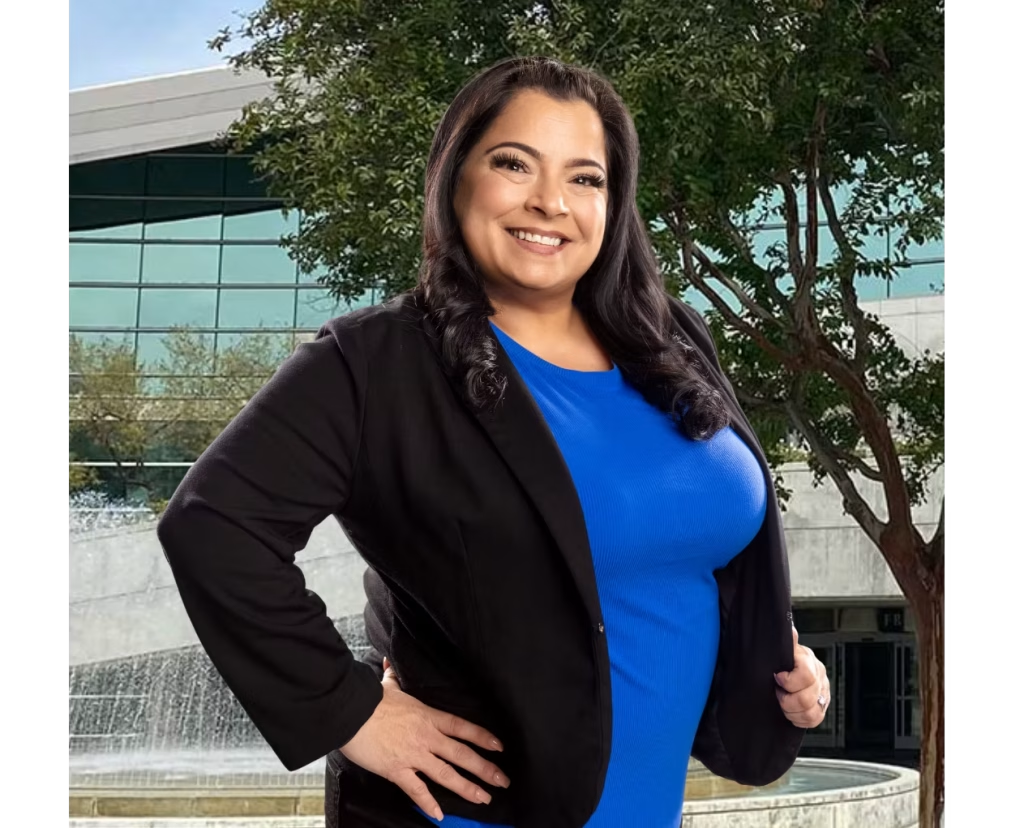
- Job: Crisis response manager, Marjaree Mason Center; formerly co-founder of Breaking the Chains, an anti-human trafficking nonprofit
- Age: Unknown
- Residency: Unknown
- Notable Endorsements: Fresno County District Attorney Lisa Smittcamp, California Republican Assembly, a conservative-faction GOP group not affiliated with the official Fresno County Republican Party
Apodaca did not respond to multiple requests for an interview from Fresnoland, but participated in candidate forums hosted by GV Wire and the Fresno Bee in April. In her closing pitch at the GV Wire forum, Apodaca said she came from “an [impoverished] family and background” and was “on the streets as early as 12 years old.”
What is her position on the Southeast Development Area plan, or SEDA?
Apodaca said the project should be greenlit because she said the city has already met its inner city development goals. “I think that I would support it as long as the policy is maintained,” she said. “The general plan does call for there to be half infill done with any new development. So I think that as long as it stays along those lines where we are taking care of both, I am in support.”
What is her position on the Elm Avenue rezone?
Apodaca was equivocal — voicing support for the 2017 Southwest Fresno Specific Plan while also questioning whether housing truly belongs in the area. “I support the Southwest [Specific] Plan as well and everything that has been put in place since 2017,” she said. “What they’re wanting to [do] by adding houses and stuff there, it doesn’t mesh up with being around all the other industrial and being next to the freeway.”
Which transportation tax plan does she support?
Apodaca opposed both new versions to replace Measure C, Fresno County’s transportation tax, on the ballot — though if forced to choose, she said she would side with the highway-heavy version championed by ex-Caltrans consultants and the county Board of Supervisors over the Dyer-backed plan that focuses on safe routes to schools and public transit.
“If I was forced to make a decision right now, I would lean more [toward the version that has 82%] toward the roads,” she said. “A lot that I’m hearing out in the community is they don’t really understand why all the money is going to bike lanes.”
How does she think transparency can be improved at City Hall?
On her website, she says she’d “ensure City Hall is transparent, responsive, and accountable—where every resident’s voice is heard and reflected in decision-making.”
What endorsements has she received?
Fresno County District Attorney Lisa Smittcamp, California Republican Assembly, a conservative-faction GOP group not affiliated with the official Fresno County Republican Party.
Who are her top donors?
Apodaca has raised around $13,000 as of late April, from individuals, businesses, and PACs.
She does not have any contributors at the $5,000 or greater level, but some of her top donors include:
- $2,500 from Brooke Ashjian, owner of Seal Rite Paving
- $2,500 from District Attorney Lisa Smittcamp
- $2,500 from Nathan Magsig for Supervisor 2028
Joaquin Arambula

- Job: California State Assemblymember, doctor
- Age: 48
- Residency: Born in Delano, grew up in the Tower (93728), where he resides now
- Notable Endorsements: Fresno Teachers Association, Fresno City Employees Association, Central Labor Council
In the Assembly, Arambula chaired the budget subcommittee on health and human services from 2016 to mid-2023, overseeing roughly a third of California’s budget. He authored Assembly Bill 4, the “Health4All” bill, championing the expansion of Medi-Cal to undocumented adults that California ultimately enacted through the state budget process. As an ex-officio member of the California High-Speed Rail Authority board, he has been one of the project’s most vocal Valley advocates.
Arambula’s run for council has been complicated by personal turmoil. In January 2026, his wife, Elizabeth Arambula, filed for divorce, alleging in court documents that he had struggled with alcohol, marijuana and gaming. Arambula said he voluntarily entered a 30-day rehabilitation program in early 2026 and completed it.
What is his position on the Southeast Development Area, or SEDA?
Arambula said he was among the first elected officials to come out against the project as currently written. He framed his opposition as both fiscal and locational.
“We need to be investing into existing neighborhoods, blighted communities,” he said, “and ensuring that before we’re beginning to create a second downtown.” Too often, he said, “we’ve done leapfrog development. We’ve done development that has not been smart growth.”
He said the project “doesn’t pencil out” because of “billions of dollars in costs that aren’t being talked about, that aren’t being addressed,” and called instead for prioritizing transit-oriented development around the future high-speed rail station.
What is his position on the Elm Avenue industrial rezone?
Arambula has come out firmly against the Elm Avenue rezone, citing the 20-year life-expectancy gap between southwest Fresno and northwest Fresno. “I’m against that Elm rezone as we can’t continue to pollute into an area that has such health disparities compared to the rest of the city,” he said. He proposed the city conduct a citywide industrial-zoning analysis.
If other parts of Fresno are insistent on accommodating the kind of industrial zoning contemplated for the Elm corridor, he said, they should “do it in their backyards” and “have their discussions with their constituents.”
How would he approach development near high-speed rail and Chinatown?
He says he secured $77 million Transformative Climate Communities investment in 2017 for southwest Fresno, downtown and Chinatown, and helped deliver the $250 million infrastructure package from Gov. Gavin Newsom for downtown’s water, sewer and parking modernization.
Arambula said the participatory budgeting process for Transformative Climate Communities shaped how he thinks about the rail station. He pointed to state investments in affordable housing in Chinatown, including the Monarch project, a 57-unit workforce housing development that Arambula said drew more than 4,000 applicants — evidence, he said, of pent-up demand to live in the urban core with the benefit of affordable housing. He said the planned multimodal transportation hub on the Chinatown side of the HSR tracks will be critical to ensuring the long-disinvested neighborhood benefits economically alongside downtown.
“We have to make sure that we’re developing but not displacing at the same time,” he said. “And that’s a tough line to walk, but you have to ground it and center it by listening to the community members.”
Which transportation tax plan does he support?
On Measure C, Arambula said he backs the Dyer-supported, city-led measure. “I have been supportive and involved with the Better Roads Safe Streets Initiative,” he said. “It was a process that included the voices of community throughout Fresno County. The measure includes the support from a broad coalition of people.”
Does he support the city’s Eviction Protection Program?
Yes — and he believes it should be strengthened. “With inflation costs rising, people are a paycheck away from being homeless,” he said. He paired tenant protections with a call for higher-wage jobs: “We need to strengthen programs that help people to stay housed, but we also have to work on creating jobs that pay well so people can make a living wage and don’t have to choose between paying rent and feeding their families.”
What’s his strategy to address homelessness?
On homeless shelters, Arambula said the city and county “need to work together,” with the county directing its social services and behavioral health budgets toward the mental health and substance abuse services tied to homelessness. Shelters, he said, “should function as transitional housing and should not be closed.” He pointed to a state housing bond as one path to building more housing stock and called for more transparency about how ARPA and city housing dollars have been spent.
How does he think transparency can be improved at City Hall?
On government transparency, Arambula backed making the council’s budget subcommittees Brown Act-compliant, with public agendas and an opportunity for residents to weigh in. “As elected officials, we need to be transparent with the budget,” he said. He also supported an independent ethics commission, saying it “would give the general public some confidence on city government.”
What endorsements has he received?
- Fresno Teachers Association
- Fresno City Employees Association
- Northern California Carpenters Union
- Central Labor Council
- Central Valley Progressive PAC
- Planned Parenthood
- California Environmental Voters
- Amalgamated Transit Union Local 1027 PAC
Who are his top donors?
Unsurprisingly, Arambula is the fundraising front-runner, raising over $116,000 in just 2025 through late April for his council run. The majority of his funds raised come from individuals, but he has also received sizeable donations from labor unions and PACs.
Donations to his campaign at or above $5,000 include:
- $5,900 from Elizabeth Simons, a major Democrat donor and chair of the Heising-Simons Foundation and the Environmental Defense Fund
- $5,900 from Nadezhda Sargsyan, a Fresno-Madera dentist
- $5,900 from The Doctors Company PAC
- $5,000 from the Fresno Teachers Association PAC
- $5,000 from the Northern California Carpenters Union
Larry Burrus

- Job: Engineering/building contractor, real estate broker, president of Burrus Financial Group
- Age: Unknown
- Residency: Unknown
- Notable Endorsements: None provided or listed
This is Burrus’s third campaign for the D3 council seat: in 2018, he won about 12% of the vote in a seven-candidate primary; in 2022, he lost outright to Miguel Arias in a three-way primary. He did not respond to multiple requests for an interview, and did not respond to Fresnoland’s candidate survey when he ran in 2022.
Who are his top donors?
Burrus has not filed campaign finance reports with the city.
Charles Montoya

- Job: Service technician for Arrow Lift
- Age: 37
- Residency: Southwest Fresno, near Olive and Polk
- Notable Endorsements: He did not share any with Fresnoland
Montoya is a first-time candidate. He said he was prompted to run by what he viewed as the weak track record of the more established candidates.
“I look at their track record as a whole, and I was very unimpressed,” he said. “Be the change you want to see in the world.”
A self-described millennial, Montoya cast his generation’s formative experiences — the 2008 housing crash and the COVID-19 pandemic — as preparation for the job. “Every millennial always talks about how they just don’t want to continue living through unprecedented times,” he said. “I like to think it’s made me tough.”
What is his position on the Southeast Development Area, or SEDA?
He said he believes “SEDA is probably going to happen no matter what,” pointing to the appeal of master-planned communities such as Tesoro Viejo. But he criticized the city’s broader pattern of avoiding hard tradeoffs, citing the looming loss of about 900 homeless beds tied to expiring federal pandemic funding. “There really isn’t a lot of forward thinking with politicians,” he said. “We knew at some point COVID was going to end. … We should have been talking with the federal government, with the state. Now, the unfortunate thing is, we’re kind of [painting] into a corner.”
What is his position on the Elm Avenue industrial rezone?
Montoya opposes the Elm Avenue rezone, citing the loss of about 500 planned housing units, the proximity to West Fresno Elementary and the risk of displacing existing renters.
He warned that approving the rezone would set off a domino effect — more industrial begets more industrial, gradually driving out southwest Fresno’s heavily renter population while only landowners profit. “There’s a lot of renters in my district,” he said. “If we start pushing them out, well, who’s going to get paid? The owners of the homes are going to get paid, not the people who are renting.”
“It might create a domino effect where we’re starting to put more industrial buildings in that area,” he said. “The last thing I want is for the air quality to get worse over there, for those kids and for the residents all over there.”
Montoya says more commercial development is needed in southwest Fresno — particularly grocery stores. He cited the Save Mart at Clinton and Brawley and the Food Maxx as the only major grocery options south of the freeway, and said one resident he met at a recent meet-and-greet drives to Kerman to shop at Walmart.
“That’s a whole different city!” he said.
How would he approach development near high-speed rail and Chinatown?
Montoya said he supports completing high-speed rail but is skeptical of how the city has handled the public realm around it. “We’ll spend $6 to $7 million on Chukchansi Park,” he said, “but the area around Chukchansi Park is not as invested into” — citing the broken elevators in the parking garage across the street.
On Chinatown, he said he is opposed to the kind of gentrification high-speed rail could bring. “Gentrification is how you get tacos for $25 that are seasoned with salt and pepper,” he said. “It’s something that nobody wants.”
Which transportation tax plan does he support?
Montoya said he backs the Dyer and city-led measure over the rival county-backed alternative, citing its emphasis on bike lanes, public transit and safe routes to schools. Bike lanes also unlock state housing requirements, he said, that come with their own benefits. “I’m leaning much more towards what the mayor is proposing,” he said, “because… I think it just benefits the residents here a little bit better.”
Does he support the city’s Eviction Protection Program?
Montoya said it would be “a little short sighted to eliminate it” given where the economy may be headed. “I think that we might be going into an era where people will have a little bit more difficult time with keeping up on their rent and on their house payments,” he said. He acknowledged the program could be abused by tenants who simply stop paying — but said, “We want to make sure that we want to help the people that really need the help.”
What’s his strategy to address homelessness?
On homeless shelter funding, Montoya was emphatic. He said the city has roughly 1,000 beds funded in part by expiring federal pandemic dollars and could lose 90% of that capacity if no replacement is found. “That’s pretty unacceptable to me,” he said. “Even if we get … 60% that’s better than … losing 90%.” He said it would be “a little embarrassing” that the city had no plan for the funding cliff and called for the council to find alternative funding.
How does he think transparency can be improved at City Hall?
Montoya said he supports making the council’s budget subcommittees public so residents can see where the money is going. But he opposes creating a new independent ethics commission. The risk, he said, is that any appointed body would be staffed through the same cross-pollinated networks it’s meant to police. “To create a truly … independent group, it would have to be journalists,” he said. “It would have to be somebody outside of the system.”
What endorsements has he received?
He has not shared any endorsements with Fresnoland.
Who are his top donors?
Montoya has not filed any campaign finance reports with the city.
Jalen Swank

- Job: Administrative caseworker for Fresno County Department of Public Health
- Age: 29
- Residency: Moved to southwest Fresno from District 1 “several years ago”, choosing the neighborhood to honor her grandmother, a longtime SW resident
- Notable Endorsements: Browns Care Transportation
Before joining the county’s public health department, Swank participated in the city’s Youth Job Corps program, eventually promoting from administrative intern to management analyst. Her last act before leaving, she said, was helping draft the $1.2 million grant application that funded the program’s next cycle. The experience, she said, is what pulled her into politics: “I kind of ended up falling in love with it.”
Swank emphasized two themes that set her apart in the field: the experience of city employees, and post-housing supportive services for the unhoused. She named the recent $15 million federal jury verdict in former code enforcement employee La-Kebbia “Kiki” Wilson’s racial discrimination, harassment and retaliation lawsuit against the city as motivation for her workforce focus.
“It will definitely be my duty to ensure that things are taken seriously when they’re taken to HR,” she said, “and that any employee can walk into my office, into my chambers, and get the assistance that they need.”
What is her position on the Southeast Development Area, or SEDA?
Swank is a no on SEDA.
“I just don’t think that’s something that’s very smart or was very thought through all the way,” she said.
SEDA would make the city more polluted, she said.
“Air quality and the pollution, that’s a no. That’s a no brainer.”
What is her position on the Elm Avenue industrial rezone?
Swank said her vote on the Elm Avenue rezone, if she were sworn in today, would be no. “I vote no on the rezone,” she said, citing pollution and the proximity to schools and farmland. She also questioned the landowners’ claim that they cannot find new tenants for the existing mixed-use parcels: “There’s plenty of things that could go down there that residents want. It doesn’t seem like they’re trying to do that.”
As a CCS caseworker, Swank said she sees the consequences of southwest Fresno’s pollution burden every day. “We talk a lot about the health disparities here and how we’re in a 20-year deficit,” she said. She also said Community Regional Medical Center’s pediatric specialty clinics closed at the end of 2025, leaving Valley Children’s Hospital and out-of-region facilities as the primary specialty options for D3 children.
How would she approach development near high-speed rail and Chinatown?
Swank said she supports finishing high-speed rail, citing businesses already lost during construction. “If you want to start something, then finish it,” she said.
But she said displacement is a real risk and that the city’s default to state law on rent regulation is insufficient. “Fresno does not have its own rent control policies; we follow the state,” she said.
“Having stricter rent control can help keep the residents in their homes.”
Which transportation tax plan does she support?
Swank said she’d back the city-led measure over the rival county initiative, citing its emphasis on public transit. “I was gonna stand with the community anyway,” she said.
What’s her strategy to address homelessness?
She also called for changes to the city’s anti-encampment ordinance. Swank said she would push for a “safe camps” or tiny-home village model where unhoused residents could keep their belongings and access security and sanitation, and could choose to “move upward” into subsidized housing if they wanted. “If they themselves don’t want to obtain housing, we can have some tiny home villages,” she said.
On homeless shelter funding, Swank was more equivocal. She said she would not support continuing programs “just to be housing.” Staffing was a key concern, she said: shelters need workers experienced in drug and alcohol counseling, not just bodies in seats. “Are we going to actually have equipped staff that are equipped in drug and alcohol counseling, that have seen those experiences?” she asked.
On housing, she said the council’s debate over what to build has skipped over what supports the unhoused. “We’re not giving them or building any type of support into these plans,” she said. “We want to be able to give them rehabilitation and upward mobility so that they can be stable and purchase their own housing — and then we can continue to bring people in.”
Does she support the city’s Eviction Protection Program?
On the eviction protection program, Swank said she would “absolutely” continue it, and said she’d look to organizations such as Tenants Together for ways to strengthen it. “Keeping people housed is something that I care about,” she said.
How does she think transparency can be improved at City Hall?
On government transparency, Swank backed making the council’s budget subcommittees public, with Brown Act-compliant agendas and notice. “We are spending the city’s budget. We’re spending the taxpayers money so that information should be public,” she said. She also said yes — without qualification — to the idea of an independent ethics commission for the city.
What endorsements has she received?
- Browns Care Transportation, a van service with Community Regional Medical Center
Who are her top donors?
Swank has not filed any campaign finance reports with the city.
Keshia Thomas

- Job: Fresno Unified School Board Trustee and nonprofit executive director of the Fresno Career Development Institute, co-founder of Golden Charter Academy
- Age: 53
- Residency: Southwest Fresno, near Chandler airport
- Notable Endorsements: Fresno City Councilmember Annalisa Perea, Fresno Unified Trustees Elizabeth Jonasson Rosas and Claudia Cazares, State Building and Construction Trades Council
Keshia Thomas declined to be interviewed about her campaign. She is only the second frontrunner candidate to refuse a Fresnoland interview since the newsroom began covering local races in 2022. The first was then–District 2 Councilmember Mike Karbassi, who refused to answer questions about his accomplishments or priorities during his 2024 re-election campaign.
Fresnoland has attempted to answer questions for Thomas based on her statements at public candidate forums.
What is her position on the Southeast Development Area, or SEDA?
Thomas was one of four Fresno Unified trustees who voted in February 2026 to indefinitely table a resolution that would have made the district the first public agency to formally oppose SEDA. The four said the project fell outside the school board’s jurisdiction.
At the Fresno Bee forum, Thomas says she hopes that the SEDA plan improves but doesn’t like the current plan.
“I would like to see what they have to offer and hopefully it’ll be better than it was.”
What about homelessness?
She says that she hopes a better relationship with the county can improve the situation.
“I don’t agree with the defecating and so on and so forth. So we have to find different avenues in order to help and invest in these people that are unhoused or homeless.”
She does not like the way the city’s anti-camping ordinance has sent more people to jail.
“It worries me when we start moving in this way because we’ll overfill the jails and it’s with people that haven’t really done anything except for not having a place to live.”
What about downtown and high-speed rail?
At the Fresno Bee candidate forum Thomas said the area “has actually gone backwards just a little bit” since the loss of Art Hop’s prominence and called for more events to draw families downtown, citing her own work programming events at Arte Américas.
She said she expects high-speed rail to “bring business into downtown” and help existing small businesses, which she said “have the most difficult time making ends meet here in Fresno.”
What endorsements has she received?
- Fresno City Councilmember Annalisa Perea
- Fresno Unified Trustees Elizabeth Jonasson Rosas and Claudia Cazares
- Former Fresno City Councilmember Cynthia Sterling
- State Building and Construction Trades Council of California
- Plumbers & Pipefitters UA Local 246
- Sheet Metal Workers Local 104
- Operating Engineers Local 3
- Fresno County Democratic Women’s Club
- National Women’s Political Caucus
Who are her top donors?
Thomas has raised almost $50,000 through late April, with sizeable contributions from both individuals and labor unions.
Donations to her campaign at or above $5,000 include:
- $5,900 from Brandon Brown, founder and executive director of School Yard Rap
- $5,000 from EV Locker, LLC, a Clovis-based EV charging company


