


What's at stake:
A Fresnoland investigation into a stalled prescribed burn project exposes systemic dysfunction at the Forest Service. Even with full state funding, political backing, and exemptions from environmental review, the Forest Service didn't act.
Years of inaction by the US Forest Service station near Fresno put one of the agency’s last stands of old growth forests in California on the brink of disaster. And then lightning struck.
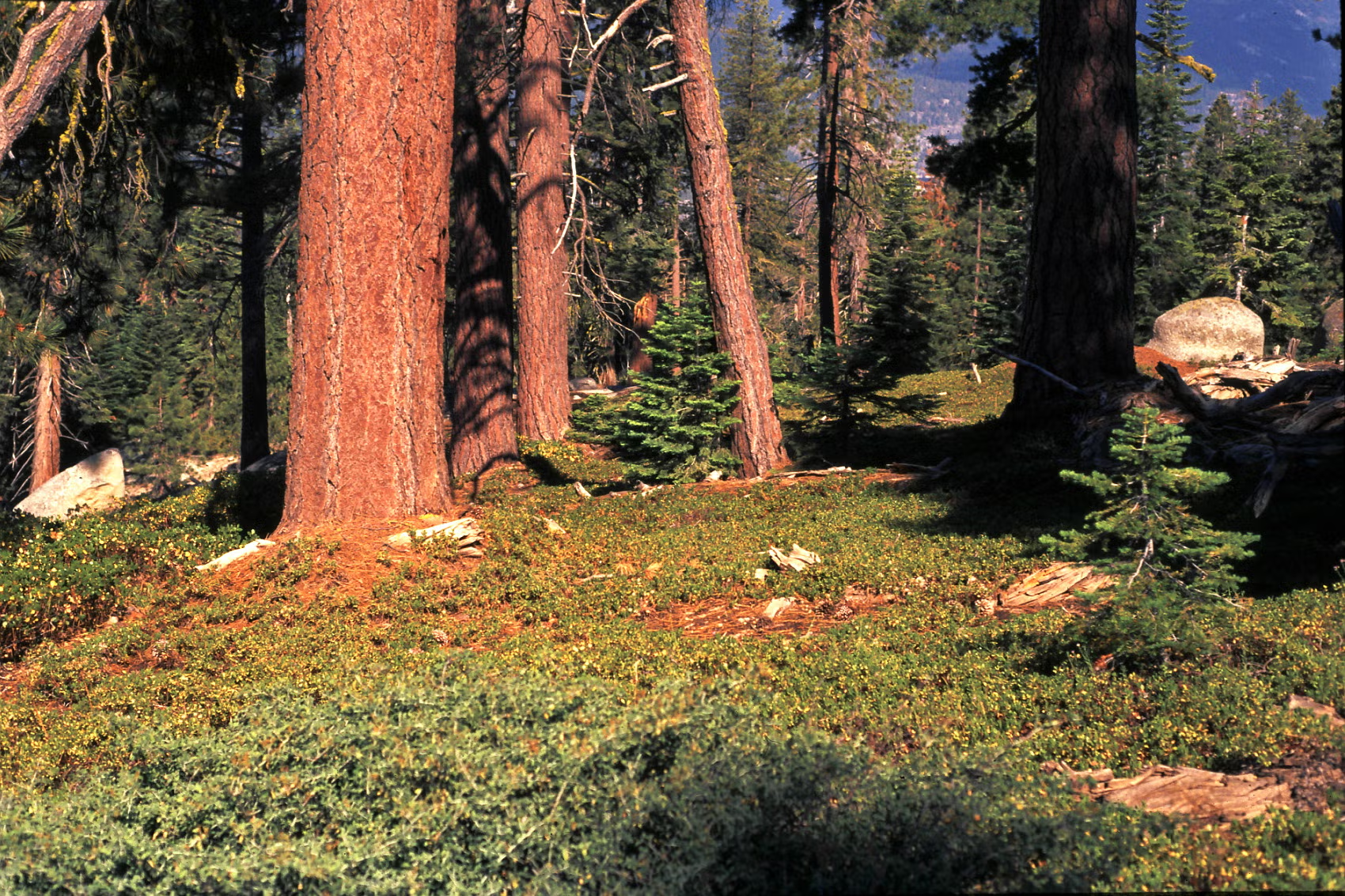
For six years, scores of scientists pressured the US Forest Service in backroom meetings to complete a prescribed burn on the Teakettle Experimental Forest, an ancient grove in the Sierra National Forest near Fresno which was widely feared to be ripe for gutting by a wicked blaze if wildfire struck.
The preventative burn had even emerged as a priority for the Newsom administration, holding potential secrets on how to meet the state’s climate goals. In 2022, a California research team bagged an “unheard of” $5.6 million grant from the administration to buy the necessary manpower to complete the 3,300-acre burn.
The project appeared to be on the agency’s fast track. With full funding from Newsom, the Forest Service promised to get the burn done by September of 2024, reducing the risk of the trees burning in a mega fire by an estimated 80%. To complete the burn as easily as possible, they exempted themselves from all the pesky red tape — no environmental review was needed to get the so-called “good fire” on the ground.
But fall 2024 came and went, and the burn didn’t get done. When the Garnet Fire started in August, the scientists’ worst fears about Teakettle proved correct.
Last month, the towering pines which had loomed over the Kings River since the days of Christopher Columbus went up in smoke. Experts say the massive trees provided a key fuel source which allowed the Garnet Fire to explode in size, later surging into the Dinkey Creek Basin and laying waste to 3,000-year-old Giant Sequoias in McKinley Grove. Most of Teakettle and its surrounding acreage is now gone forever – a blanket of ash on the forest floor.
Two months later, the scientists who were part of the stalled project say that the worst of the devastation caused by the Garnet Fire could have been prevented had the Forest Service not found ways to drag its feet every step of the way with the Teakettle burn project. Many pin the blame on the Forest Service supervisor Dean Gould for “slow-rolling” the project despite hundreds of thousands of dollars being spent to hold his staff’s hand on nearly every planning detail of the project.
“We got slow-rolled on everything,” said Matt Hurteau, director of the Center for Fire Resilient Ecosystems and Society at the University of New Mexico and project leader for the Teakettle Project.
“The National Forest Service leaders put in charge of these local ranger districts have no urgency to their actions. They’re not moving at a pace that’s going to result in forests that are resilient to these big wildfire events.”
Scott Stephens, a UC Berkeley professor of Fire Science, said the Teakettle project points to deep dysfunction within the Forest Service, which has failed to implement the forest treatments since the 2020 Creek Fire that are necessary to stave off the collapse of the Sierra Nevada ecosystem in the coming years.
“It really was a lack of engagement from the local unit,” said Stephens on why the Teakettle project didn’t get done. “I don’t know what else to say about it.”

Gould and his U.S. Forest Service office could not be reached for comment via email despite repeated requests both before and after the government shutdown.
Top Forest Service scientist Malcolm North told the San Francisco Chronicle that Teakettle’s 500-year-old trees are gone for good because of the Garnet blaze.
“It’s probably going to be a case where some of the trees didn’t burn, but it’s unlikely they’ll still be alive next summer,” he told the Chronicle.
UC Berkeley’s Stephens points out that rival federal agencies and private landowners near Fresno have already implemented proscribed burning and similar forest treatments to great success.
But the Forest Service under Gould’s management is moving in the opposite direction.
Gould’s team has reduced the amount of forest treatments conducted near Fresno by 50% since 2018, according to the Forest Activity Tracking System (FACTS), the Forest Service’s standard project database. Under his office’s current pace of treatment – less than 6,000 acres a year – a patch of forest under his jurisdiction stands to be treated once every 1,000 years.

The loss of Teakettle Forest has shaken the faith of local residents in the Forest Service and Gould’s leadership. Many of them say that Gould has failed to protect local forests and its prized recreation areas. Thousands have signed a petition calling for his resignation.
“There’s no lessons learned from the Creek Fire,” said Frede Serrano, a Fresno native who launched the petition. “The negligence is awful. Who’s being held accountable?”
Surrendering to forest breakdown
To be sure, the collapse of the Sierra Nevada is not unique to Gould’s area, most of which is being transformed from a forest into a glorified weed patch by the unprecedented flame of mega fire. Forests are not adapted to fires this hot, said Stephens, and as a result the old ecosystems are not growing back.
But Fresno County has emerged as the signal fall-out zone of this broader national crisis. The 65,000-acre Garnet Fire this August jumped the last remaining river on the Southern Sierra to not be crossed by megafire over the last decade. The mountains lining the eastern edge of the San Joaquin Valley now have an unbroken 90-mile trail of recent megafires stretching from Fresno to Bakersfield.
America’s founding environmental historian – an expert on how failed agricultural policy instigated the Dust Bowl in the 1930s – wonders if this trail of devastation is a sign that California is entering something like a 21st century Dust Bowl.
“Are we creating another Dust Bowl in the forests of the West?” asked Donald Worster, emeritus professor at University of Kansas.

The clouds of dust which menaced the Texan panhandle 90 years ago, Worster says, certainly do bear a stark resemblance to the county-spanning clouds of smoke that are now routine occurrences across the West.
The costs of breathing in this modern-day smoke bowl, often containing brain-stunting heavy metals like lead and other carcinogens, are $200 billion, a U.S. Congress Joint Economic Committee report found.
With total economic damages running up to $1 trillion annually, that’s a cost on par with the entire Pentagon budget.
Experts say that the rapid implementation of prescribed burning is the only way to prevent these damages from happening. Without rapid implementation, the Biden Administration concluded in a report since wiped from the Forest Service’s webpage, 100 million acres of Forest Service land could burn a year by the end of the century.
“Logging and thinning by themselves may only aggravate the fireshed,” said Stephen Pyne, America’s pre-eminent fire historian.
Fresno County’s 2020 Creek Fire was a window into the Forest Service’s role in creating this new age of megafire, according to Stephens. From the air, the fire’s mushroom cloud of smoke near Shaver Lake looked less like a natural occurrence than a nuclear bomb detonation.

Stephens concluded in a 2022 paper that the devastation of the Creek Fire, the hottest in California history at the time, had nearly nothing to do with climate change or the 2012-2016 drought. It had to do with the neglect to do prescribed burns or other types of treatments which would have made the area’s trees more resilient.
Before the Creek Fire, up to two-thirds of the Forest Service’s trees which eventually burned were already dead, Stephens discovered, due to Bark beetle infestations.

That death rate was 500-600% higher than nearby patches of forests just down Tollhouse Road which had been more progressively managed by Southern California Edison. Eighty percent of the Creek Fire’s intensity was explained by this massive build-up of dead trees, Stephens’ statistical models concluded.
For 25 years, Southern California Edison forest manager John Mount said he tried to get the local Forest Service, led by Gould, to save these trees. But his lobbying fell on deaf ears, he said.
“I went to meetings for 25 years and listened to their gobbledygook,” Mount said. “I tried to help, but it didn’t work.”

Through the 2010s, Mount said he grew progressively more concerned as he watched beetle-infested trees on National Forest Service land accumulate on his property line. Since the last big clear-cut in the 1980s, the area had become packed at densities 200-400% higher than normal.
The Forest Service’s overstocked stands spread water too thin for any tree to thrive, making them too weak to fend off bark beetles.
When the Creek Fire hit, the result was that Mount’s forest – thinned to support far bigger and more resilient trees – survived. But the Forest Service’s got annihilated.
“They had managed it so poorly,” Mount said. “They did these little tiny burns here and there. But they haven’t done a real big burn since the 90s.”

A deep cynicism had set in at the local Forest Service, Mount recalls.
“One meeting, they looked across from me and said ‘Don’t listen to him, we can’t do the things he does.'”
Second time’s a charm?
For years, the Forest Service suppressed prescribed burning and befriended the logging industry. The agency’s formative leaders in the 1920s argued that suppressing fire would help preserve the biggest trees for the timber industry to harvest, according to Pyne, the fire historian.
“The logging stripped off so much of the original forest – broke the old order – which then regrew without the pruning effect that historic fire regimes had provided,” Pyne said.
This new forest regime became a ticking time bomb once the big trees were ripped out and the timber industry pulled back from harvesting National Forest lands in the late 1980s. The National Forest Service was quickly gutted of staff – never to recover.
Since the early 1990s, the number of foresters employed by the agency has declined 74%, according to a 2019 report. Forestry technicians, who assess and manage forest health, were once the biggest group of employees in the Forest Service but have declined 50%.

In the wake of the Creek Fire, restaffing the agency has been a major cause taken up by Fresno’s Congressman Jim Costa.
“To better prepare our communities and the National Forest for possible wildfire, we must ensure that the Forest Service has sufficient resources and adequate staffing,” Costa wrote this September to USDA Secretary Brooke Rollins, who oversees the Forest Service, about Trump Administration cuts to the agency.
But in Costa’s backyard, the failure to complete the Teakettle burn project shows that the Forest Service’s problems run far deeper than mere funding. Both Democratic and Republican administrations have been unable to overcome the Forest Service’s resistance to prescribed burning, said Stephens, the UC Berkeley Forest Science Professor.
“I think there’s been a lack of leadership at high levels, saying ‘we’re going to embrace this and start to move,'” Stephens said. “Randy Moore [the previous chief of the Forest Service under the Biden administration] wasn’t able to move the dial here. That’s just a fact.”
At the high noon of the Biden Administration, such a problem was at play when a team of insiders took the baton from Mount and tried to get the Teakettle project done.
A formidable team formed around the project. Spearheaded by a former Cal Fire chief deputy director, high-powered scientists and ex-hotshots from the US Forest Service, a new wildfire think tank called the Climate and Wildfire Institute tried their hand at getting “good fire” done on the Sierras.
Rather than an outsider like Mount pressuring the Forest Service, the team built a bridge into the heart of the agency. Malcolm North, a top Forest Service scientist who had staked his career on studying the giant Sugar Pines of Teakettle, came on board with supervising the burn’s planning stages.
But even this expanded network of reformers couldn’t gain traction with the Forest Service.
The team cleared most of the often-cited hurdles for the Forest Service – regulations, money and manpower. The federal agency still failed to get the prescribed burn done.
The old-growth forest near the Kings River hadn’t experienced wildfire since 1865 and the burn project gained steam as a follow-up from Stephens’ research showing massive risk reductions for forests treated with prescribed burns. The California Air Resources Board gave funding for the project as a study to understand how these risk reductions in old-growth forests like Teakettle would suck up planet-warming gases.

But even with $5.6 million in hand, the project team failed to get full buy-in from the Forest Service team near Fresno.
“It didn’t feel like a priority,” said Byron Krempl, a consultant on the project.
It only took a few steps to hit snags with the Forest Service.
In early 2019, Professor Matt Hurteau got $135,000 from Cal Fire to hire a contractor for field surveys on the burn project. He initially estimated that the work would be completed by March 2023.
The Forest Service took years to provide the contractors with a complete list of where those surveys needed to be conducted, according to three project team members who spoke with Fresnoland.
“I hired a contractor to do the biological survey work, and she couldn’t get anybody on that district to even respond to her with, what are your requirements for surveys?” said Hurteau, the professor of biology at the University of New Mexico who led the Teakettle research effort.
It wasn’t until late 2024 – four years later – that complete information was provided to the Teakettle team on where field surveys would ultimately be needed for the burn to move forward.
The delay was so severe, Hurteau said he had to file two extension requests with his funders. He said it was shocking to see the “snail-like pace” at which the National Forest moved, given the stakes of the forest.
“Were these guys ever committed to do this work?” Hurteau asked.

Such a delay was unheard of, said Gus Smith, a retired Forest Service district ranger who described the state’s support for the project as exceptional. The only explanation he could give for the delays was that the Forest Service local office didn’t plan on doing the project in the near term.
“It’s possible that this prescribed burn was not prioritized by the Forest [Service]. And so it’s got a low priority, and therefore, even though it’s funded, we can’t commit to it because we don’t have the people to do the work, right?” Smith said.
Krempl said that the Forest Service had been involved in more routine calls with the Teakettle team earlier this summer.
But Forest Service documents obtained by Fresnoland, some publicly available, others acquired from the research team, show that the project wasn’t on the planning board with the Forest Service. Despite Gould’s team writing in public-facing memos that the project would be completed in the fall of 2024, there was no such plan actually in place inside the Forest Service.
A three-year work plan shared by Gould’s team with Teakettle project members last fall showed that the burn was not on the Forest Service’s to-do list.
Fourteen other projects appeared in the plan.

The Forest Service’s work plan database tells the same story. Teakettle wasn’t listed in the FACTS database either, which tracks all planned and completed projects across the National Forest system. Seven other projects in the district were listed for future completion this year.
“The conservation community has invested a huge amount of time and energy in planning and trying to work with the Forest Service,” said Zeke Lunder, a fire analyst who interviewed the Teakettle project team on his show, called The Lookout.
“But they talk a big game and nothing ever happens. How long does the conservation community keep pretending that the Forest Service is a good partner?”
A valley native says enough is enough
Frede Serrano has spent the better part of 15 years watching the forests above Fresno collapse. When the Garnet Fire ignited last August, he’d had enough.
“You start to see how things have changed around you,” Serrano said. “Looking at the campsites, they started shutting down campsites, and it’s like, what’s going on here? Well, the trees are dying.”
When the Garnet Fire started burning toward the wilderness he’d spent years exploring, Serrano started the petition calling for Gould’s resignation. At least 2,700 people have signed it.
“When this petition we started, I never thought it was going to kind of blow up the way that it did,” Serrano said.
“It seems like active negligence, to me,” Serrano said. “It’s almost criminal.”
He worries that even if Gould is replaced, the next person could be worse. But doing nothing isn’t an option anymore, he said.
“I don’t know how much more can burn,” Serrano said. “But I can tell you one thing right now, when you look at some of the areas that the Creek Fire impacted five years ago, it’s ready to burn again.”


Comments are closed.